
What Gilmer County Deeds Record
The Gilmer County Clerk keeps the deed records at 10 Howard Street in Glenville. Each index entry shows the document type, date, parties, book and page, page count, cross-date, and instrument reference. A deed is just one kind of land instrument. The file holds other interests too. The Clerk's public type menu spans several deed forms plus related documents that shape how land may be used or transferred. A parcel file is rarely only deeds.
| Deed Type | What It Does | Common Use |
|---|---|---|
| Deed | Records a conveyance of an interest in land | Follow a grantee to the next grantor |
| Deed of Trust | Secures an obligation against land | Pair with assignments and releases |
| Plat or Plat in Deed Book | Records a mapped layout or lot description | Identify lots, roads, and shared boundaries |
| Easement or Right of Way | Records access or another land-use interest | Check rural access and road crossings |
| Tax Deed or Trustee Sale | Records a transfer following a sale process | Confirm with sale and court records |
A deed transfers an interest. A deed of trust or lien records a claim against it, while a release shows an earlier claim being discharged. The label alone proves nothing about current status. Read the related releases, assignments, court filings, and later deeds in Gilmer County before concluding that a lien stands or a sale closed.
Walking the Gilmer County Party Index
The Gilmer County Clerk IDX splits a search into Index, Sub Index, Type, and Book. Party roles go well beyond buyer and seller. Choices include Grantor, Grantee, Creditor, Debtor, Deceased, Infant, Personal Representative, Groom, and Bride. A grantor conveys; a grantee receives. Search as grantee to trace an acquisition. Then mine the names on that document for earlier or later Gilmer County filings, since the index states no earliest year or image fee.
- Search the known owner as Grantee and narrow by document type or date.
- Open the result reference and record the grantor, grantee, date, instrument, and book/page.
- Search the grantor as Grantee to locate the earlier acquisition of the same tract.
- Compare the legal description at each step; a name match alone can point to another parcel.
- Grantor
- The person or entity that gives or conveys an interest.
- Grantee
- The named person or entity receiving that interest.
- Chain of title
- The sequence of recorded transfers tied to one tract.
- Book and page
- A location reference for a document in the Clerk’s records.
- Instrument
- A recorded legal document identified in the index.
Obtaining a Gilmer County Deed Copy
Start with the free online index. Record the full name, the date, the document title, and the book and page before you go further. The County publishes no image-access price and no certified-copy schedule online.
For a certified copy, or when the image is missing, call the County Clerk at 304-462-7641 or visit 10 Howard Street, Glenville, WV 26351. Ask how copies are issued and what they cost. Confirm the price before you send any payment.
Recorded, not guaranteed. A Gilmer County deed record shows a filing, not a legal opinion that title is clear. Unrecorded interests, later documents, or a different legal description may change the result.
Instrument Names in Gilmer County
Search the Clerk's categories past the plain "Deed" label. The index identifies Deed of Trust, extension notices, modifications, assignments, subordinations, releases, federal and state tax liens, judgments, mechanics liens, HOA liens, lis pendens, trustee sales, tax deeds, cemetery deeds, and estate documents. That is a wide net. These labels can point to a property interest that never shows up in an owner search. Rural land adds more terms. Right of Way, Road Book Easement, Plat, Plat in Deed Book, oil and gas lease, and lease assignments matter especially on rural parcels in Gilmer County. A record may sit under Miscellaneous. The Gilmer land-record guide lists local instrument types and helps form a search vocabulary. The county land-record guide gives examples of instrument labels. Each label can steer a Gilmer County property search toward the right book.
Let the guide widen the net. When one deed cannot explain access, liens, or a transfer, the instrument lists point to the next place to search in Gilmer County deed records.
Gilmer County Index Result Fields
The IDX result schema includes Index, Image, Flag, Status, Date, Document, Book Page, Pages, Sub, Name, Cross Date, and Instrument. Search options are just as broad. They include Indexes, Sub Indexes, Types, Books, name components, party role, "Sounds Like," and associated records. The county posts no populated example. The visible columns describe the result structure but do not establish image availability or redaction behavior. Record every field you see. Copying only a party name can cost you the useful parts. A cross-date can connect related filings in Gilmer County. A book/page gives the Clerk a clean reference. The instrument type separates an assignment from an original lien, so note the party names, date range, document type, and book/page for any copy request.
Historic Gilmer County Deed Coverage
Older Gilmer County property records run deep. The Archives inventory lists deed books from 1845 through 1902 and a separate deed index from 1845 through 1969. Trust deeds cover 1894 through 1903. Releases and release indexes sit alongside them. The inventory also covers delinquent tax sales from 1848 through 1872, wills from 1845 through 1969, and broad fiduciary and court series. These are archival spans, not the web index's start. For a chain reaching before online records, use the State Archives and WVU finding aids to identify the reel or book. Then ask the holding office about access and copies. An 1888 courthouse fire left gaps, so reconstruct early ownership from later deeds and related probate or court records. The West Virginia State Archives inventory documents Gilmer deed books and the older index.
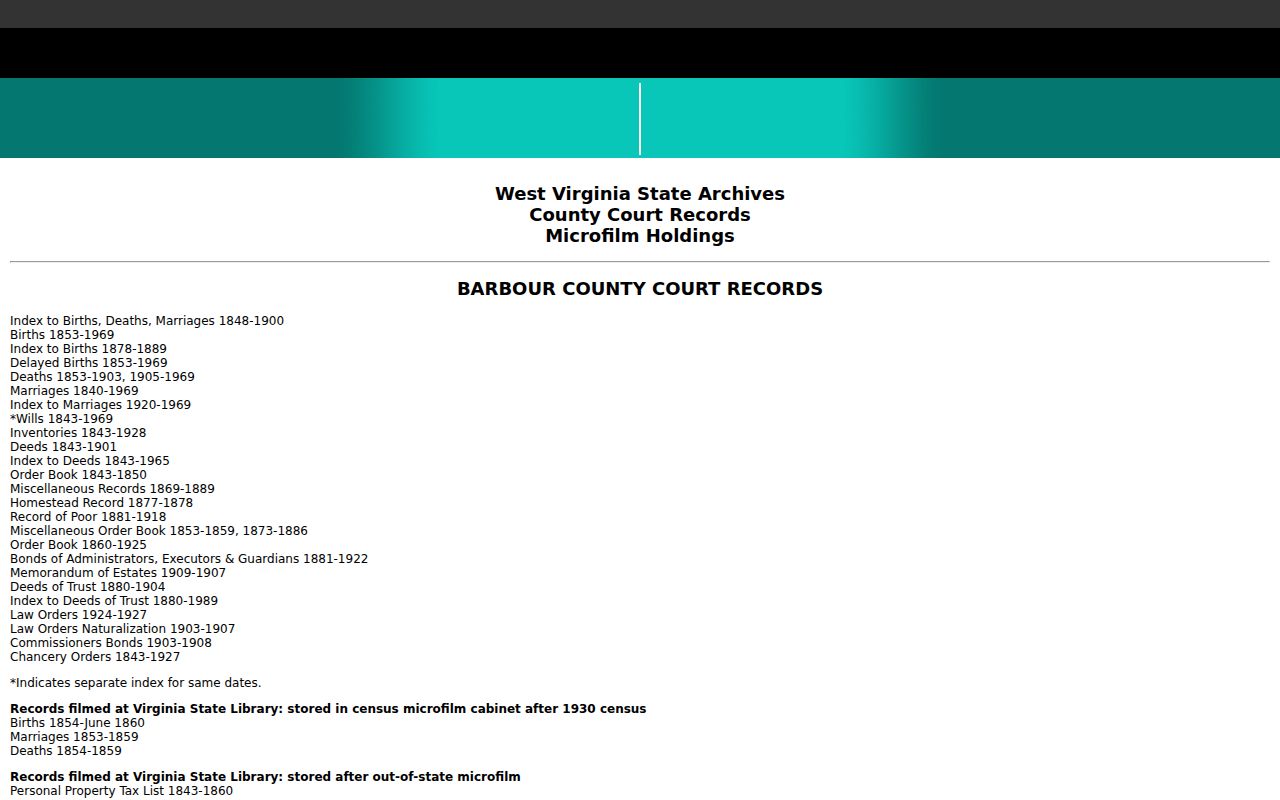
Start with the listed series and years. Then cite the reel or book reference in your copy request to the office holding the Gilmer County records.
Heirs, Wills, and Transfer Affidavits
An owner's death sends a chain through estate papers rather than a normal sale deed. Gilmer County's IDX covers wills, fiduciary filings, inventories, settlements, appointments, small estates, affidavits of heirs, and affidavits confirming transfer-on-death beneficiaries. Search both names. Use the deceased owner and the personal representative. Then compare the later deed or affidavit that describes the land.
A will alone shows intent, not ownership. Read it beside the probate file and the recorded conveyance. Estate authority, a court order, or a beneficiary affidavit can explain why the next grantee differs from the name on the old tax roll. The Archives also list wills and inventories that extend an older chain.
When a Deed Search Meets Court Records
Court files often explain what the deed index cannot. A lis pendens, a foreclosure, a partition suit, a quiet-title case, or a judgment can sit behind a later transfer. It can also sit behind a recorded lien. The WV Judiciary county page lists circuit, family, and magistrate contacts for Gilmer. No statewide online case-search form with verified fields exists. Request the case file from the clerk directly. Party name, case number, parcel, or legal description will help the clerk find it. A date range will help too.
Next, lay the court order beside the Clerk index. Look for a release, a trustee-sale report, a tax deed, or a later conveyance. A notice or sale entry alone does not prove a sale closed. Ask whether the file sits in storage and what copies cost. The Judiciary's Gilmer contacts point to the right court offices.
Search Business and UCC References
Businesses show up in Gilmer County deed records too. A company, a trustee, or a firm can hold title or sign as a party, and the West Virginia Business Organization Search helps sort out which entity is which. It accepts organization and agent, officer, and name queries, with a percent-sign wildcard plus advanced fields for address, county, record ID, and entity type. A detail page may list office addresses, officers, incorporators, annual reports, and amendments. That clarifies a name on a deed. It does not establish parcel ownership by itself.
UCC filings run on a separate track. Ordinary land mortgages and liens stay in the County Clerk index, while the Secretary of State handles UCC searches by debtor, secured party, or filing number, with filters for active and lapsed filings. The official business search and UCC procedure page help interpret state filings.
Take an Online Search into the Archive
The Clerk's public IDX is a strong tool for finding an instrument reference. The office publishes no firm oldest online year. Document images may not be free. A result's book, page, and date give the Clerk a far sharper request. A party name alone works less well. An empty name search is not the end. Try spelling variants and the other party role. A deed may sit under the grantor, grantee, fiduciary, or another listed role.
For older ground, the State Archives inventory lists Gilmer County deed books from 1845 through 1902. It also lists a deed index from 1845 through 1969. Those spans do not promise every volume is online. The inventory notes the 1888 courthouse fire as well. That fire can explain a gap or a missing instrument. Work backward from the latest known grantee through earlier grantors. Record every citation. Then ask the Clerk or the archival repository which series covers the missing period. Later deeds, probate files, and releases often recite earlier ownership. A first instrument may still prove impossible to locate.